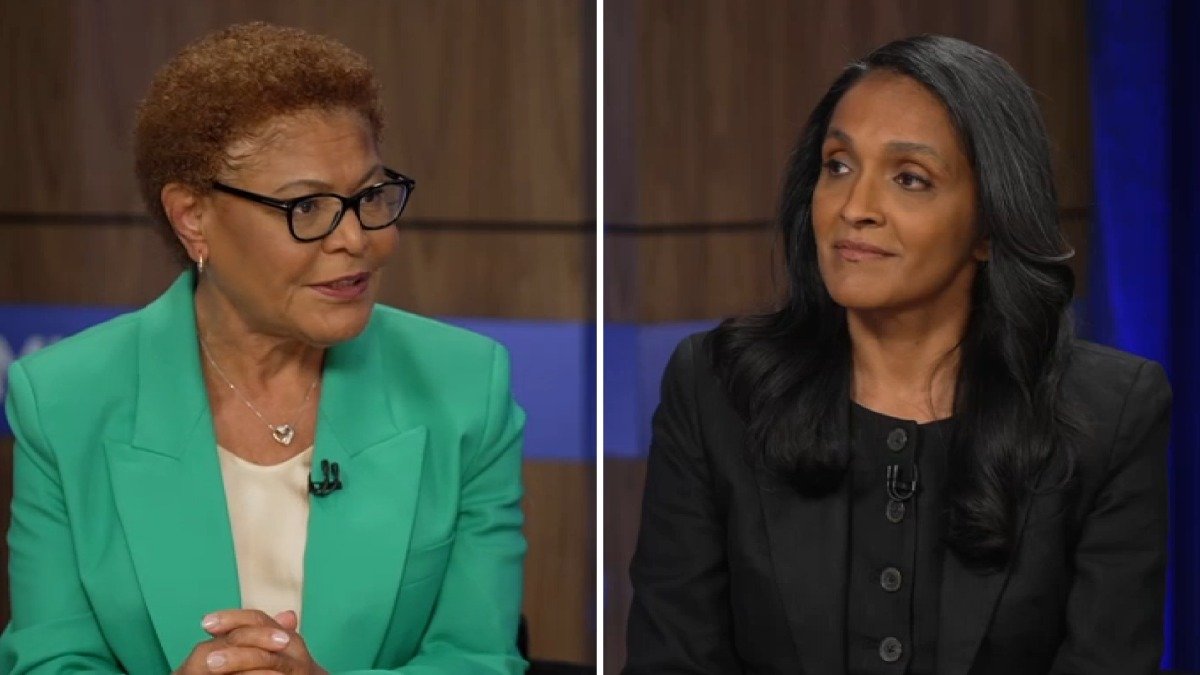
In the last Los Angeles mayoral debate before the Nov. 3 election, incumbent Karen Bass faced one of the toughest challenges of her 25-year political career: challenger Nithya Raman, once a political ally, who aggressively attacked the mayor’s record while making the case that she could do a better job leading the City of Angels.
Bass and Raman participated in the live one-hour, commercial-free debate, hosted by NBC4 and Telemundo 52 Tuesday night. Topics included public safety, homelessness, housing and economic development as the candidates made their appeals to voters.
These are the top takeaways from the debate.
It became abundantly clear that Raman, who had endorsed Bass for reelection before deciding to challenge her, is no longer on friendly terms with the mayor.
Several times during the debate, Raman accused Bass of misrepresenting her record.
One exchange involved what appeared to be a private conversation the two women had in the past. Bass claimed she had offered to “take care of (Raman’s) constituent issues” four years ago, when Raman was experiencing difficulties with residents in her district.
“I made a deal with you four years ago because you had so many problems with your constituents,” Bass said.
Raman immediately pushed back.
“This is a lie,” she responded.
Bass later went further, alleging that Raman had a strained relationship with residents in her own district.
“Because she is contemptuous of her constituents, they call my office and reach out to my office to get the situation handled,” the mayor said.
Raman called Bass’ claim “completely untrue.”
Raman repeatedly stressed that she tried to change the system from within, seeking to portray Bass as part of the political establishment at a time when younger, progressive candidates are gaining prominence nationwide.
Raman, who has served on the City Council since 2020 and chaired its Housing and Homelessness Committee for three years, said she pushed for reforms to improve the city’s response to homelessness, including greater oversight of how public funds are spent.
“For the first time, thanks to my work on that committee, we have performance data about homelessness in the city that I use to fill every shelter bed in my district,” Raman said.
Raman has pointed to the committee’s work on tracking city spending and performance metrics as evidence of her approach to addressing homelessness. The city’s homelessness oversight efforts have included monitoring spending and tracking key performance indicators.
Bass, meanwhile, questioned whether Raman was equipped to lead a city of 3.8 million people facing a range of complex challenges.
When the candidates discussed a social media video in which Raman and a digital influencer appeared to call Bass and LAPD Chief Jim McDonnell “fascist liars,” the mayor said the incident showed Raman “is not ready for prime time.”
“It made me wonder whether you understand what the word ‘fascist’ means,” Bass told Raman.
The candidates also clashed over Raman’s proposal to replace McDonnell before the 2028 Los Angeles Olympics.
Bass argued that replacing the police chief so close to the Games would disrupt the department as it prepares for a major international event.
“We are 640 days away from the largest sporting event to ever take place, a major national security event. And if you think that you’re going to find a police chief, you would send the department in disarray by doing that,” Bass told Raman.
Bass and her supporters, including Councilmember Monica Rodriguez, highlighted Raman’s lack of support among her City Council colleagues, including some progressive members.
The mayor pointed to criticism from Councilmember Imelda Padilla, who served with Raman on the Housing and Homelessness Committee and has described difficulties working with the mayoral challenger.
“Your colleagues have a very difficult time working with you,” Bass said. “How on earth are you going to manage the second-largest city in the country?”
Raman countered that the lack of support from her colleagues was unsurprising, given their alignment with the incumbent mayor.
“My colleagues had no trouble putting me in leadership on the council, making me the chair of one of the most powerful committees before I decided to push back against a system that I saw was failing Los Angeles when I decided to run against you, Mayor Bass,” Raman responded.
The exchange highlighted a central contrast in the candidates’ arguments: Bass emphasized the importance of working relationships across City Hall, while Raman presented herself as a reformer willing to challenge the political establishment.
Throughout the debate, Bass cited figures she said showed progress under her administration, including an 11% reduction in street homelessness and a 50% decline in veterans’ homelessness.
The mayor acknowledged that homelessness figures can vary depending on the metrics and time periods used but argued that her administration had made progress.
Bass also credited her Inside Safe program with helping reduce homelessness in Raman’s district.
Raman disputed the mayor’s broader claims of success, criticizing the cost of Inside Safe and what she described as a lack of transparency and accountability.
“Under this mayor’s leadership, we have poured hundreds of millions of dollars into an incredibly expensive program, Inside Safe, which has been unaccountable to the public for which she has refused audits, and which has brought down homelessness a little bit, but at extraordinary cost, and now we see it ticking up again,” Raman said. “There has been no adaptation. There has been no changes to the program to make it more cost-effective.”
During the debate, Raman said she would not repeal Los Angeles Municipal Code (LAMC) Section 41.18, which currently makes it illegal to have homeless encampments in front of schools, daycare centers and parks.
The disagreement reflected the candidates’ competing approaches to the crisis. Bass has championed Inside Safe, which moves people from encampments into temporary housing, while Raman has advocated for expanding rental assistance and improving oversight of homelessness spending.
Although Bass and Raman are both Democrats and have criticized the Trump administration’s immigration enforcement operations, they sharply disagreed over policing and public safety.
Bass argued that public safety is a mayor’s foremost responsibility, criticizing Raman for opposing a pay raise for LAPD officers and voting against measures to remove homeless encampments near schools.
“(Raman) has consistently voted against police officers. She has consistently voted to not remove encampments in front of schools, so parents and kids have to navigate their way through,” Bass said. “To go with this candidate is really taking a serious risk.”
Raman reiterated her call to replace McDonnell, arguing that the police chief had “lost the trust of Angelenos, especially in response to the ICE raids.”
When asked about the process for replacing the chief, Raman acknowledged that the mayor cannot make the decision unilaterally and would need to work with the Police Commission and other officials.
“I will work towards it,” Raman said.
The debate underscored the candidates’ competing arguments on public safety: Bass emphasized police staffing, continuity in leadership and encampment enforcement, while Raman focused on accountability and the LAPD’s response to federal immigration operations.
This story uses functionality that may not work in our app. Click here to open the story in your web browser.