
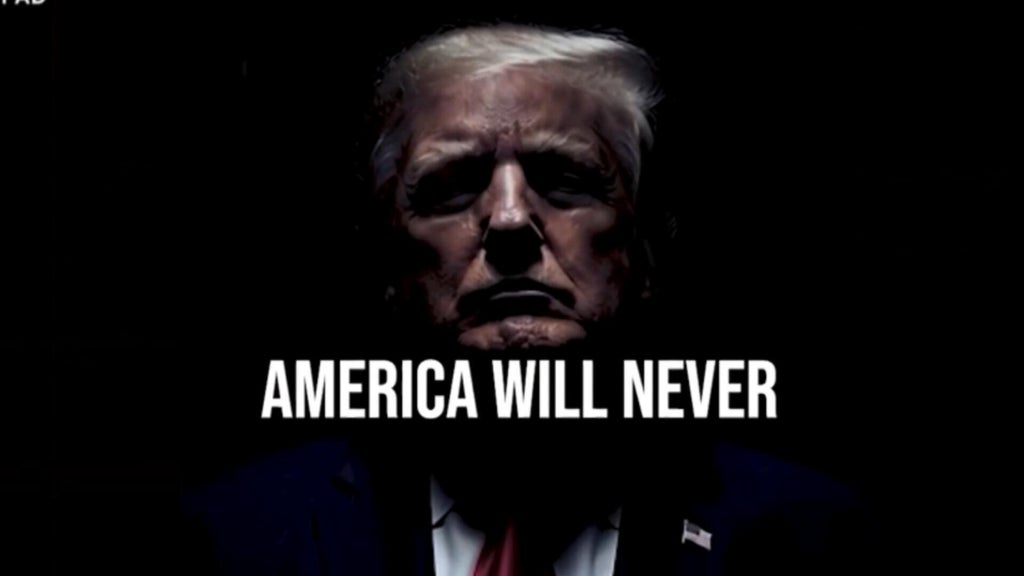
President Trump must cancel any remaining television commercials paid for with millions of dollars in taxpayer money to promote his political message, a federal judge ordered Sunday night, even as the administration said the ad campaign was coming to an end.
U.S. District Judge Jennifer L. Rochon in New York sided with a coalition, including the nonpartisan watchdog Common Cause, which challenged the ads as an illegal misuse of funds. She ordered the administration to cancel any remaining ads, including any set to air Sunday night, in granting a temporary restraining order.
"Defendants shall not enter into, renew, or expand any agreement authorizing the development, creation, dissemination, placement, or airing of the challenged advertisements" during the two-week duration of her order, the judge said.
The order was in effect as of 6:45 p.m. ET on Sunday.
The spending on cable and broadcast for the five Trump ads that disclose on screen that they were "paid for by the U.S. Government" now exceeds $20 million, according to political ad tracker AdImpact. That's the amount the Department of Homeland Security had allocated for a "National Media Campaign," awarding a contract for the ads to Maryland-based LMD Agency on Sept. 20. A day earlier, the White House Office of Management and Budget had granted DHS's Customs and Border Protection $20 million for "OBBB Commemorative Events," according to a nongovernment database. The source of the funds was first reported by The Washington Sun.
By Monday morning, AdImpact showed U.S. government spending on the five ads had reached $21,705,138. (Because the ads were classified by the White House as PSAs, AdImpact may not reflect the exact total amount spent.)
Here are the five ads listed in AdImpact and the amount spent, as of Monday:
Asked for comment, the White House referred to an Oct. 5 social media post from Mr. Trump in which he defended the taxpayer-funded ads as "rather standard" but after Republicans criticized the use of taxpayer money to air the ads, he said he would pay for them from his own political fundraising. In a court filing late Saturday, the Justice Department argued that the temporary restraining order was unnecessary because "the alleged offending conduct will end tomorrow."
Legal experts have suggested that the use of taxpayer money for the ads violated a federal statute against congressionally appropriated money being used for "publicity or propaganda" and potentially other laws.
"We are pleased the court acted swiftly to prevent more taxpayer dollars from being used for such blatantly unlawful political propaganda," the plaintiffs said in a statement issued by Democracy Forward, the nonprofit legal organization that represents them. "There is no legal justification — and no precedent — for the president to use the machinery of the government and funds set aside by Congress for other uses to influence electoral outcomes that further his own agenda."
In a court declaration Saturday, senior DHS official Holly Mehringer wrote that the money had come from congressionally appropriated funds that are "available for, among other things, 'commemorating efforts and events related to border security.'"
The White House has defended the ads as public service announcements similar to those of past administrations to promote various policies. But the recent ads differ from many past public service announcements because they aren't aimed at helping the public benefit from specific government programs.
A White House official said last month the PSAs "are clearly not political," and noted: "The President is not on the ballot and the ads don't have a call to action."
Top Republicans who criticized the use of public funds include Senate Majority Leader John Thune, of South Dakota. "It shouldn't be paid for with taxpayer dollars," Thune told reporters.
On "Face the Nation," GOP Sen. John Kennedy of Louisiana said last month, "I don't think any public official, including President Trump or [former DHS Secretary] Kristi Noem or John Kennedy, should spend public money on private ads for themselves."
The Democratic National Committee has separately sued the Republican administration over the ads.
"This is the sort of government propaganda one might expect in North Korea, not the United States of America, and it is an egregious and illegal misuse of Americans' hard-earned tax dollars," a group of Senate Democrats said in a letter last month.
Amid the backlash, Mr. Trump said he would start paying for the ads with political funds. A White House official said there were no immediate plans to reimburse the government for money already spent.


